
Digital accessibility has become an essential factor in modern application development. In addition to improving the user experience and ensuring that anyone can interact with a digital environment without barriers, the new European regulations will require, as of June 28, 2025, that numerous digital products and services meet specific accessibility requirements. This new scenario forces companies to adapt their applications and platforms to respond to both user needs and legal requirements.
However, complying with the regulations goes far beyond a specific technical adaptation. It involves understanding what criteria should be applied, how they affect the design and development of applications and what aspects are really essential to guarantee an inclusive experience. In this article you will discover everything you need to know to understand the new obligations, avoid possible non-compliance and prepare your digital products for a future where accessibility will be an essential standard.
1. Overview
1.1 What is accessibility?
Digital accessibility refers to the ability of websites and digital applications to be used by everyone, regardless of their physical, sensory, or cognitive abilities. This includes, for example, people with visual or hearing impairments, mobility difficulties, or comprehension challenges.
An accessible digital environment removes barriers and ensures that any user can navigate, understand, and interact with the application’s content.
1.2 What are the guidelines that determine if a website is accessible?
The main international standard for accessibility is defined by the WAI (Web Accessibility Initiative), an organization affiliated with the W3C. These guidelines are embodied in the WCAG (Web Content Accessibility Guidelines), which establish criteria to ensure that digital content is perceptible, operable, understandable, and robust.
The WCAG defines three levels of compliance:
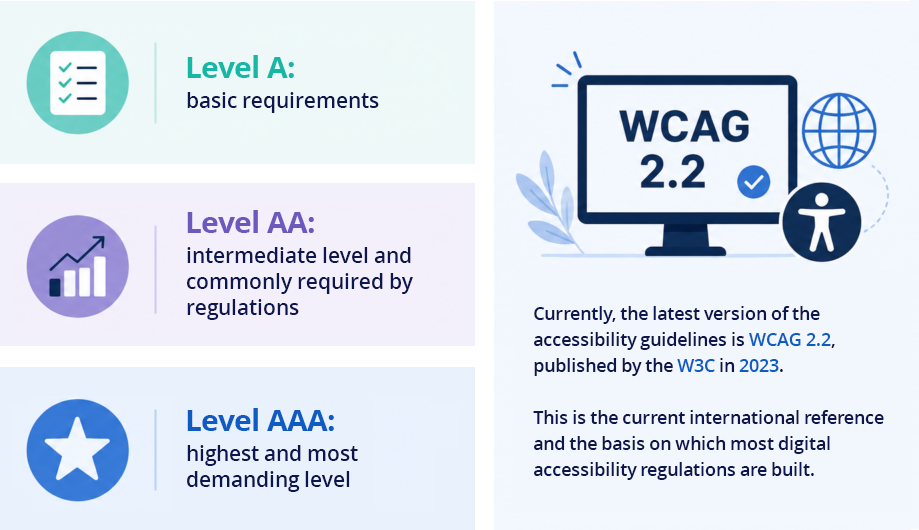
Currently, the most recent version of the accessibility guidelines is WCAG 2.2, published by the W3C in 2023. This is the current international standard and the foundation upon which most digital accessibility regulations are built.
In practice, most regulations establish Level AA as the mandatory standard.
Later, we will examine in practical terms what an application should and should not have to comply with Level AA accessibility.
1.3 What are the advantages of an accessible website?
Beyond legal compliance, accessibility provides direct benefits for organizations:
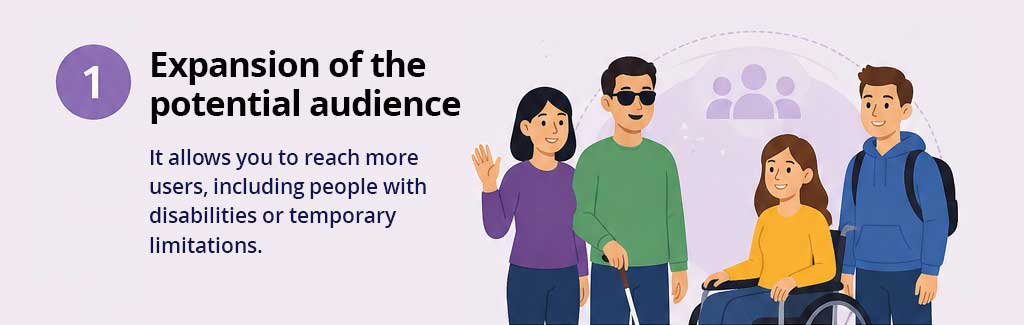
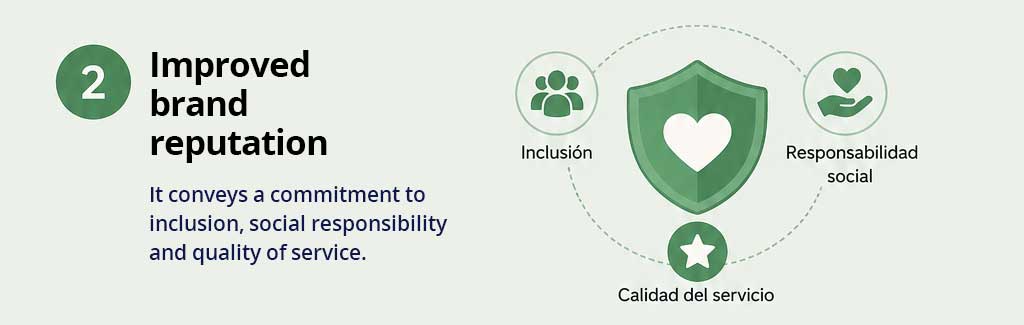
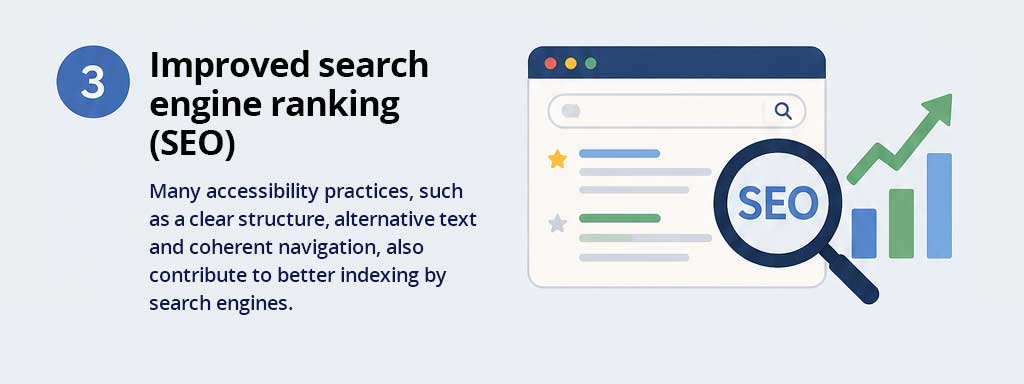
In this sense, accessibility is not only an obligation in certain cases, but also an opportunity to improve the user experience and the overall performance of digital channels.
2. Legal framework
2.1 What framework regulates digital accessibility?
Digital accessibility is primarily regulated at the European level.
The key legislation is the European Accessibility Act, which establishes common requirements to ensure that certain digital products and services are accessible.
This law came into effect on June 28, 2025. At the Spanish level, the Directive has been transposed through specific legislation, primarily Law 11/2023, which specifies accessibility obligations, as well as monitoring mechanisms and the sanctions regime.

In addition, previous regulations governing the accessibility of public sector websites and applications already existed, mainly Royal Decree 1112/2018, which establishes accessibility requirements for websites and mobile applications of public administrations.

Finally, from a technical perspective, the UNE-EN 301 549:2022 standard defines the applicable accessibility requirements and serves as a reference for verifying compliance. It is the technical document that explains, in concrete terms, what must be met to be considered accessible.
2.2 Who is obligated to comply with it?
The accessibility requirement depends on the type of organization and the service offered.
Generally, the following are required to comply with accessibility requirements:
- Public administrations and related bodies
- Digital applications from private companies with functionalities that are not only informative, in which users can register, make purchases, contract services or manage accounts or data.
In these cases, the rule explicitly includes:
- E-commerce (any website or app that allows you to buy products or services)
- Financial services (banking, insurance) or Transport (ticket sales, route information, mobility apps)
- Telecommunications (operators, electronic communication services)
- Digital services with direct user interaction (websites and apps that allow you to contract, buy or manage services).
Companies with fewer than 10 employees and an annual turnover of less than €2 million are exempt from complying with this regulation. In these cases, the regulation stipulates that the exemption only applies if compliance would impose a disproportionate burden on the company, and the company must be able to justify this if requested.
2.3 What are the penalties for non-compliance?
Failure to comply with the regulations may result in financial penalties and other corrective measures.
In the case of Spain, the sanctions regime falls within the general legislation on the rights of persons with disabilities, and generally includes:

Financial penalties, which may vary depending on the severity.

Mandatory adaptation requirements.

Possible claims by users or organizations. The sanctioning process may be initiated by an action of the public administration, by claims from users, or by complaints from organizations or associations that defend the rights of people with disabilities.
Beyond the penalty, the reputational risk and the potential loss of users if digital services are not accessible must be taken into account.
3. What must be fulfilled?
3.1 What level of accessibility is mandatory?
Generally, regulations require websites and applications to comply with Level AA of the WCAG (Web Content Accessibility Guidelines).
This level is the most widely used international standard and the one that best balances requirements with technical feasibility; it is also the level required by the European Accessibility Act.
3.2 What does achieving AA level entail?
Level AA is not a single, specific action, but rather a set of criteria that ensure the website is usable for most people.
Broadly speaking, it means the website should be:
- Perceptible
The content must be understandable by everyone (for example, alternative text for images or subtitles in videos). - Operable
The website must be usable with different devices and navigation methods (e.g., using only a keyboard, without needing a mouse). - Understandable
The content and navigation should be clear and predictable. -
Robust
The website must function correctly with different browsers and assistive technologies (such as screen readers).

3.3 The regulations define the what, not the how.
The WCAG guidelines define very specific criteria that websites and applications must meet, but not in the form of a closed technical checklist; rather, they present verifiable functional criteria.
This means that:
- They don’t tell you exactly how to program or design a website
- But they do establish conditions that must be met. How each solution is implemented may vary depending on the project, but the result must meet these criteria.
3.4 Specific examples of requirements (AA level)
To make this more tangible, an accessible website should guarantee, among other things:
- Alternative text in images so that they can be interpreted by screen reading devices
- Good color contrast to facilitate reading
- Keyboard navigation without locks or inaccessible elements.
- Clear structures (titles, menus, forms) that help to understand the content
- Accessible forms with clear labels and understandable error messages
- Subtitles in audiovisual content
In Annex 1 we include a full breakdown of the WCAG guidelines requirements for the AA level.
3.5 Key point: it’s not just a technical issue
Meeting AA level standards means ensuring that the website or app is usable for the majority of users, regardless of their abilities, and requires a comprehensive approach encompassing design, content, and development.
Accessibility compliance involves more than just making isolated changes; it also includes:
- Take it into account from the design stage
- Apply it during development
- And maintain it over time with each update
3.6 Is it possible to not meet a criterion and justify it?
Based on the concept of “disproportionate burden,” the regulations allow an organization to disregard a specific requirement if it can demonstrate that the cost or effort is excessive in relation to the organization’s resources and the benefit to users.
In this case, justification and documentation are required. A justified assessment must be conducted, documenting which criterion is not met, why it cannot be met, and what alternatives have been considered.
This justification must be included in the accessibility statement.
3.7 Accessibility Statement
The accessibility statement is the document that reports on the level of compliance of a website or application, as well as any existing limitations.
It is mandatory for public sector companies, and while the law does not explicitly require it in the private sector, it does require transparency regarding the level of accessibility and its compliance. In practice, it is becoming increasingly common in the private sector as a best practice, especially to meet information requirements and mitigate risks.
The accessibility statement must include the following:
- The date of creation and the evaluation method (self-evaluation or external audit)
- The level of compliance (full, partial, non-compliant)
- The criteria that are not met, with the justification and possible alternatives available.
- The contact mechanism for reporting accessibility issues, requesting accessible information, or filing a complaint.
The accessibility statement must be easily accessible from any page of the website.
It is most commonly placed in the footer, within the legal terms, or with a link such as “Accessibility” or “Accessibility Statement.”
The accessibility statement is a transparency measure, but it does not exempt websites from complying with the accessibility requirements established by regulations. It allows for visibility into the accessibility status of their services, but it cannot be used as a mechanism to avoid adapting digital services.
4. Planning to implement accessibility in a project
Accessibility is an ongoing process that must be integrated into the design, development, and maintenance of digital products.
The approach to ensuring a project meets accessibility guidelines differs depending on whether it’s a new project or an existing one.
4.1.How to apply accessibility in a new project
The most efficient way to achieve AA level is to incorporate accessibility from the start.
Design
- Define accessibility criteria from the beginning (colors, contrasts, fonts)
- Design clear structures and consistent navigation
- Provide accessible components (buttons, forms, menus)
Development
- Use proper semantic HTML
- Ensure keyboard navigation
- Properly implement accessibility labels and attributes
Contents
- Write clear and structured texts
- Add text alternatives to images
- Prepare accessible audiovisual content
Validation
- Perform reviews using automated tools
- Conduct manual checks
- If possible, test with users
4.2. How to adapt an existing website or app
Once the project is in production, the usual process is progressive and structured.
1. Accessibility audit
- WCAG Compliance Analysis (A+AA)
- Identification of Barriers and Incidents
- Classification by Criticality
2. Plan of action
- Prioritizing changes (impact vs effort)
- Definition of implementation phases
- Risk identification
3. Implementation
- Correction of technical problems
- Design and content adjustments
- Adaptation of key components
4. Validación
- Re-evaluation of compliance
- Try assistive technologies
- Functional validation
5. Maintenance
- Incorporate accessibility criteria into new features
- Review new content
- Establish internal processes

